

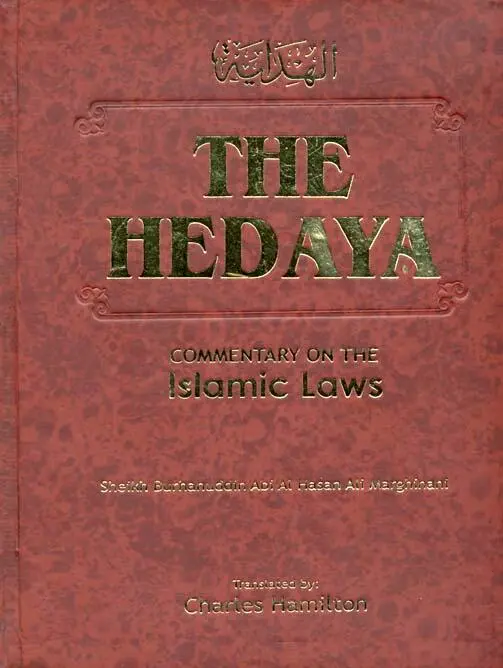
The Hedaya
The Ḥadāyah is one of the most important classical texts in Hanafi Fiqh, written by Burhān al-Dīn al-Marghinānī (d. 593 AH / 1197 CE).
The Hedaya (al-Hidayah) af Burhan al-Din al-Marghinani – klassisk manual i hanafi-fiqh.
Bogen er på engelsk.
In English
The Hedaya (al-Hidāyah fī Sharḥ Bidāyat al-Mubtadī) is one of the most influential classical manuals of Ḥanafī Islamic law (fiqh). It was written by the renowned jurist Burhān al-Dīn al-Marghīnānī (c. 1135–1197 CE), who is sometimes referred to by his honorific "Shaykh Burhān al-Dīn." Although some people simply call him "Sheikh Burhanuddin," his full name is Burhān al-Dīn Abū al-Ḥasan ʿAlī ibn Abī Bakr al-Marghīnānī.
Overview
The Hedaya is a comprehensive commentary on al-Marghīnānī's earlier legal primer, Bidāyat al-Mubtadī. Rather than merely listing legal rulings, it explains the reasoning behind them, compares different juristic opinions within the Ḥanafī school, and occasionally discusses the views of other Sunni schools.
For over 800 years, it has been one of the principal textbooks in traditional Islamic seminaries throughout Central Asia, the Indian subcontinent, the Ottoman Empire, and beyond. It remains a core text in many madrasas today.
Purpose
The book was written to:
- Present the authoritative positions of the Ḥanafī school.
- Explain the legal evidence and reasoning behind rulings.
- Resolve differences among earlier Ḥanafī jurists.
- Serve as an advanced textbook for students and a reference for judges (qāḍīs) and muftis.
Subjects Covered
The Hedaya covers virtually every area of Islamic law, including:
Acts of Worship (ʿIbādāt)
- Purification (ṭahārah)
- Prayer (ṣalāh)
- Fasting (ṣawm)
- Zakāh
- Hajj
Family Law
- Marriage
- Dowry (mahr)
- Divorce
- Maintenance
- Child custody
- Inheritance
Commercial Law
- Buying and selling
- Partnerships
- Leasing
- Loans
- Agency
- Guarantees
- Pledges
Criminal Law
- Fixed punishments (ḥudūd)
- Retaliation (qiṣāṣ)
- Blood money (diyah)
- Judicial procedure
Other Topics
- Waqf (endowments)
- Oaths and vows
- Hunting and slaughter
- Warfare and treaties
- Judiciary and evidence
- Emancipation of slaves
Methodology
One of the book's greatest strengths is its legal methodology. Al-Marghīnānī typically:
- States the official Ḥanafī ruling.
- Presents differing opinions among major Ḥanafī authorities such as Abū Ḥanīfah, Abū Yūsuf, and Muḥammad al-Shaybānī.
- Explains the supporting evidence from the Qur'an, Sunnah, consensus (ijmāʿ), analogy (qiyās), and juristic reasoning.
- Clarifies why one opinion is preferred over another.
This makes the Hedaya much more than a legal handbook—it is also a work of legal analysis.
Importance in Islamic Scholarship
The Hedaya became:
- One of the most authoritative texts of the Ḥanafī madhhab.
- A standard reference for judges across the Muslim world.
- A central teaching text in institutions such as Dār al-ʿUlūm Deoband and many other traditional seminaries.
- A source frequently cited in later legal commentaries and fatwa collections.
Its influence extended beyond the Muslim world. During British rule in India, an English translation of the Hedaya was used by colonial courts to help administer Islamic personal law.
English Translation
The best-known English version is:
The Hedaya, or Guide, translated by Charles Hamilton (1791), based on a Persian translation. Although historically important, Hamilton's translation uses archaic English and occasionally reflects the limitations of translating through Persian rather than directly from Arabic.
Modern readers often consult newer Arabic editions alongside contemporary commentaries for greater accuracy.
Strengths
- Comprehensive treatment of Islamic law.
- Clear presentation of the Ḥanafī legal tradition.
- Rich discussion of legal reasoning.
- Extensive comparison of juristic opinions.
- Enduring influence on Islamic jurisprudence.
Who Should Read It?
The Hedaya is best suited for:
- Advanced students of Islamic law.
- Ḥanafī scholars and researchers.
- Muftis and judges.
- Historians of Islamic legal thought.
It is not an introductory book for beginners. Readers generally benefit from prior knowledge of fiqh terminology and legal methodology, or from studying it with a qualified teacher.
Overall Assessment
The Hedaya is regarded as one of the masterpieces of classical Islamic jurisprudence. Al-Marghīnānī combined precision, depth, and clarity to produce a work that has shaped Ḥanafī legal scholarship for centuries. Its systematic organization and careful legal reasoning have made it one of the most respected and enduring works in the Islamic legal tradition.
Der er endnu ikke nogen anmeldelser her. Vi vil være glade for hvis du vil anmelde som den første.


