

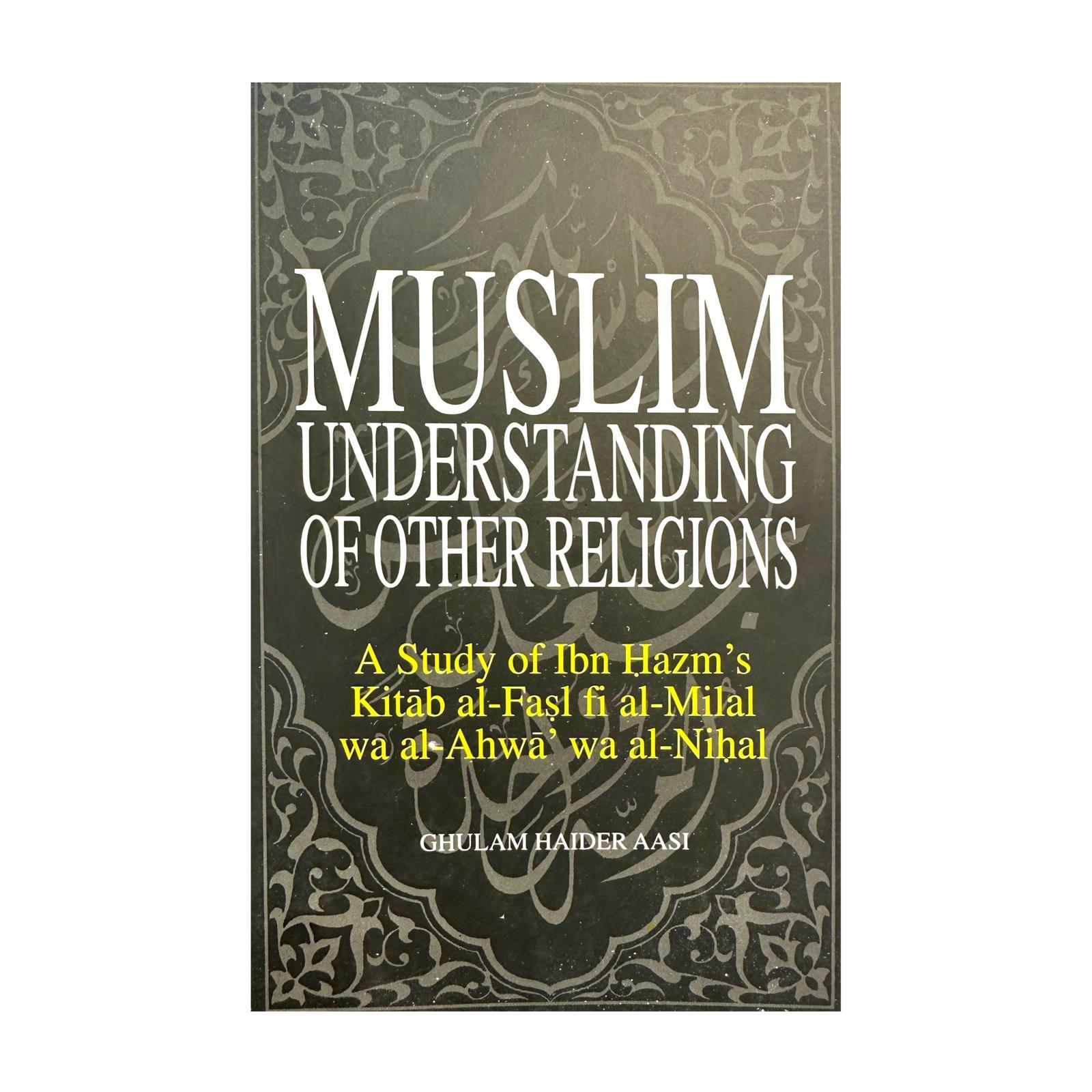


Muslim understanding of other religions
Af Ghulam Haider Aasi
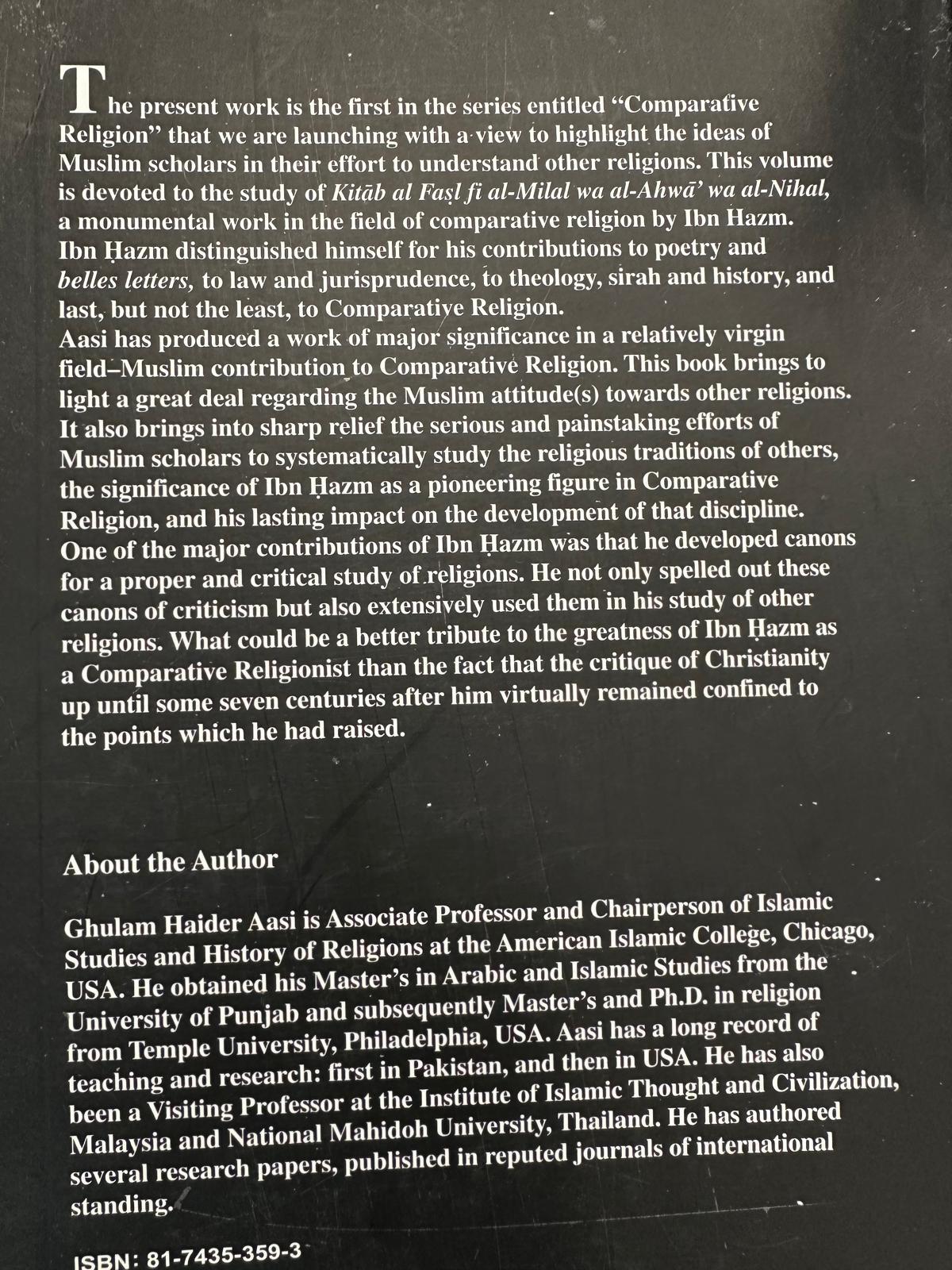
Muslim Understanding of Other Religions: A Study of Ibn Ḥazm's Kitāb al-Faṣl fī al-Milal wa al-Ahwāʾ wa al-Niḥal is an academic work by Dr. Ghulam Haider Aasi, first published in 1999 by the International Institute of Islamic Thought (IIIT) and the Islamic Research Institute, Islamabad. The book is based on Aasi's Ph.D. dissertation at Temple University and examines the comparative religion methodology of the 11th-century Andalusian Muslim scholar Ibn Ḥazm (994–1064).
Overview
Rather than being a general introduction to Islam's view of other religions, the book is a detailed study of how Ibn Ḥazm approached Judaism, Christianity, Zoroastrianism, and other religious traditions. Aasi argues that Ibn Ḥazm was one of the earliest Muslim scholars to develop a systematic methodology for the academic study and critique of religions.
Main Themes
1. The Qur'anic foundation for studying other religions
- Aasi begins by examining Qur'anic references to religious diversity.
- He explains how the Qur'an recognizes previous revelations while maintaining that Islam is the final revelation.
- The book discusses concepts such as Ahl al-Kitāb (People of the Book), prophethood, revelation, and religious dialogue.
2. Historical Muslim encounters with other faiths
- The author surveys the interaction between Muslims and followers of Judaism, Christianity, Zoroastrianism, Hinduism, and other traditions during the early centuries of Islam.
- He demonstrates that Muslim scholars produced substantial literature describing and evaluating other religions.
3. Ibn Ḥazm's life and intellectual background
- A significant portion of the book introduces Ibn Ḥazm's life in Muslim Spain (al-Andalus).
- It explains how his legal, theological, and historical scholarship influenced his comparative study of religions.
4. Ibn Ḥazm's methodology
Aasi argues that Ibn Ḥazm employed several principles that were advanced for his time:
- reliance on original religious texts whenever possible,
- logical and textual analysis,
- comparison of doctrines,
- internal consistency as a criterion,
- critical examination of historical transmission.
According to Aasi, these methods anticipated later approaches in comparative religion.
5. Ibn Ḥazm's critique of Judaism and Christianity
The largest section analyzes Ibn Ḥazm's arguments concerning:
- Biblical textual transmission,
- the doctrine of taḥrīf (textual alteration),
- Christian doctrines such as the Trinity,
- Christology,
- prophecy,
- scriptural interpretation.
Aasi explains Ibn Ḥazm's reasoning rather than simply endorsing it, placing his arguments within their historical and theological context.
Scholarly Contributions
The book argues that Ibn Ḥazm:
- helped establish comparative religion as a distinct field within Islamic scholarship,
- developed clear criteria for evaluating religious claims,
- influenced later Muslim scholars who wrote about other faiths,
- combined theological commitment with systematic textual analysis.
Strengths
Scholars generally regard the book as:
- one of the first comprehensive English-language studies of Ibn Ḥazm's work on comparative religion,
- well researched, with extensive references to classical Arabic sources,
- valuable for students of Islamic theology, interfaith studies, and intellectual history. A published review in Intellectual Discourse describes it as an important contribution to the study of Muslim approaches to other religions.
Who Should Read It?
The book is especially useful for:
- graduate students in Islamic studies,
- researchers in comparative religion,
- scholars of Christian-Muslim relations,
- readers interested in classical Islamic intellectual history.
It is not written as a popular introduction. The discussion is academic, with detailed engagement with Arabic texts, theological debates, and historical scholarship.
Overall Assessment
Muslim Understanding of Other Religions is an important scholarly examination of Ibn Ḥazm's pioneering work in comparative religion. Ghulam Haider Aasi shows that medieval Muslim scholarship included rigorous and systematic engagement with other faith traditions, highlighting both its theological commitments and its analytical methods. The book remains a valuable resource for understanding how one of Islam's most influential medieval thinkers approached the study of religion from both a historical and methodological perspective
Es existieren noch keine Bewertungen - geben Sie zuerst eine ab.


