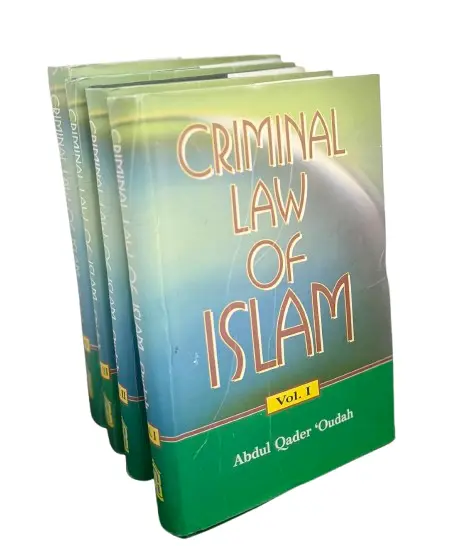
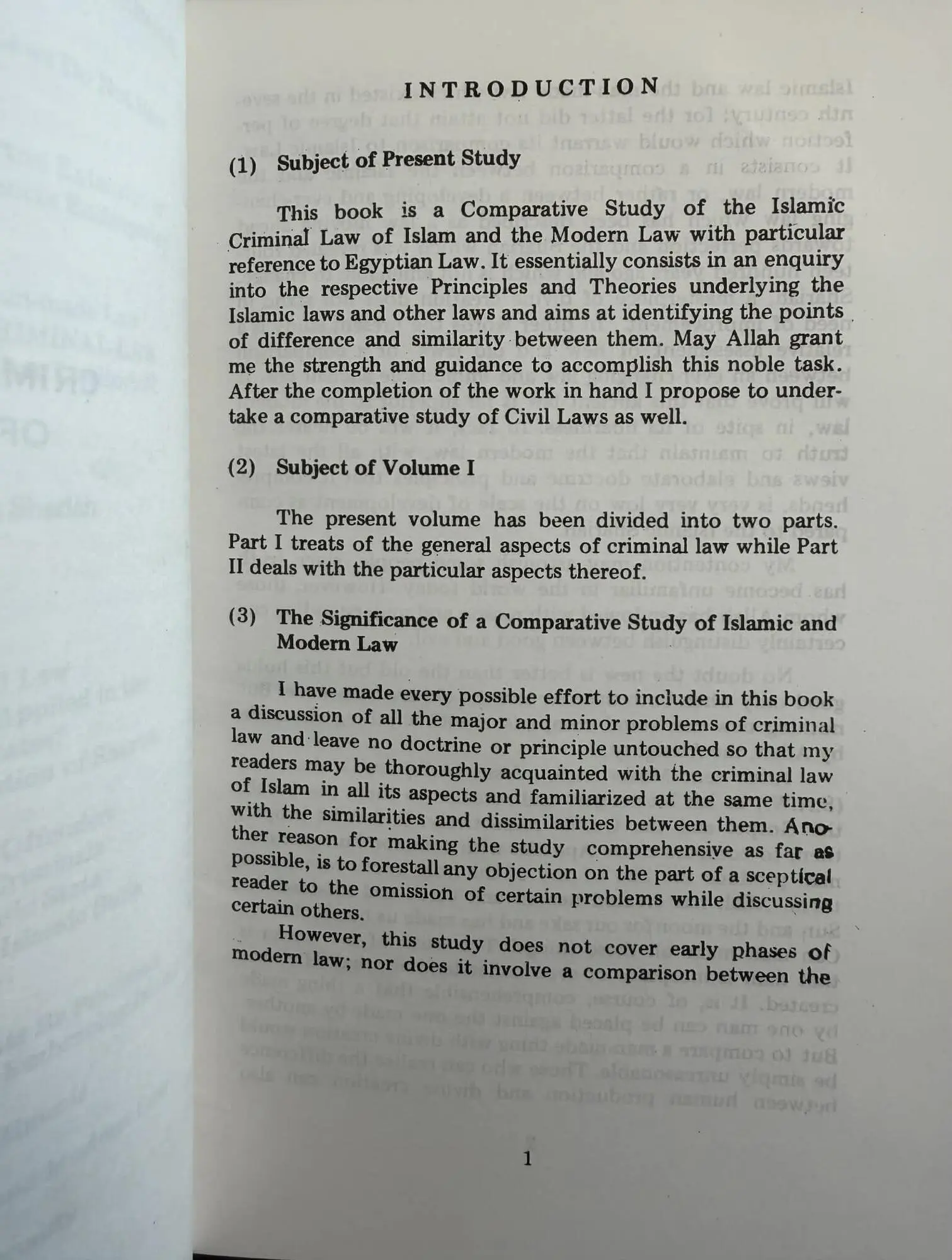
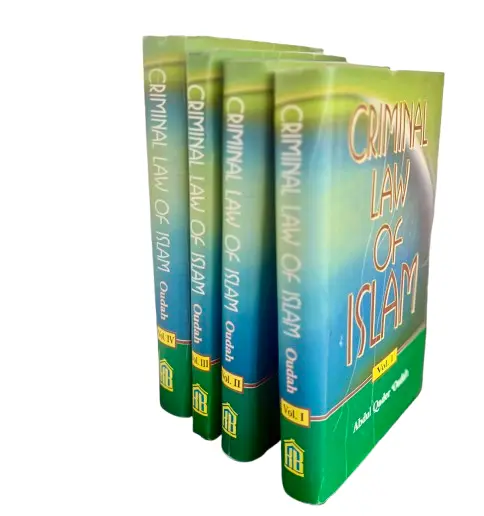
Criminal Law of Islam” (4 Volumes) by Abdul Qader Oudah Shaheed (A.Q. Oudah) is a major scholarly work on Islamic criminal jurisprudence (Sharia criminal law). The book analyzes the principles, philosophy, and legal rules governing crimes and punishments in Islamic law and compares them with modern secular legal systems.
Below is a clear description of the work and its four volumes.
Overview of the Book
The book is a comprehensive academic study of Islamic criminal law that explains how criminal justice operates under Sharia. It examines:
-
The foundations of Islamic legal theory
-
Types of crimes and punishments
-
Evidence and court procedures
-
Comparisons between Islamic and modern Western legal systems
The author attempts to demonstrate the logic, moral reasoning, and objectives behind Islamic punishments, such as justice, deterrence, and social stability.
The complete set contains four volumes with about 1,200–1,300 pages.
Author
Abdul Qader Oudah (1906–1954)
-
Egyptian jurist and Islamic scholar
-
Member of the Muslim Brotherhood
-
Executed by the Egyptian government in 1954 and therefore referred to as “Shaheed” (martyr).
His work is considered influential in modern discussions about applying Islamic law.
Main Themes of the Book
The book discusses several key areas:
1. Philosophy and Purpose of Islamic Criminal Law
Oudah argues that Islamic criminal law aims to:
-
Protect religion, life, property, honor, and intellect
-
Prevent crime through deterrence
-
Maintain justice and moral order in society
Islamic criminal law derives its rules mainly from the Qur’an and the Hadith, interpreted through Islamic jurisprudence (fiqh).
2. Categories of Crimes in Islamic Law
The book explains the classical division of crimes into three main categories:
Hudud
Fixed punishments defined in the Qur’an or Hadith. Examples include theft, adultery, false accusation, and drinking alcohol.
Qisas
Retaliatory justice for crimes against individuals such as murder or bodily harm, allowing equal retaliation or compensation (blood money).
Ta’zir
Crimes not specified in scripture where punishment is determined by the judge or ruler.
Description of Each Volume
Volume 1
Focuses on theoretical foundations of Islamic criminal law:
-
Sources of Islamic law (Qur’an, Sunnah, consensus, analogy)
-
Objectives of punishment
-
Principles of criminal responsibility
-
Comparison with secular legal philosophy
It explains how Islamic law defines crime and legal accountability.
Volume 2
Deals mainly with general principles of criminal liability:
-
Intention and criminal responsibility
-
Participation in crime
-
Attempted crimes
-
Circumstances that remove liability (coercion, mistake, necessity)
It also analyzes how Islamic law determines guilt.
Volume 3
Examines Hudud crimes in detail:
Examples covered include:
The volume discusses the strict evidentiary rules required before punishment can be applied.
Volume 4
Discusses Qisas and Ta’zir crimes, including:
-
Murder and bodily injury
-
Compensation (diya / blood money)
-
Judicial discretion in punishment
-
Criminal procedure and evidence
-
Role of judges and courts
It also compares Islamic judicial practice with modern criminal law.
Importance of the Book
This work is widely regarded as:
-
One of the most detailed modern studies of Islamic criminal law
-
A bridge between classical Islamic jurisprudence and modern legal theory
-
A reference for students of Islamic law, comparative law, and Islamic studies
The book attempts to show how Islamic law forms a complete criminal justice system, combining moral principles with legal rules.