
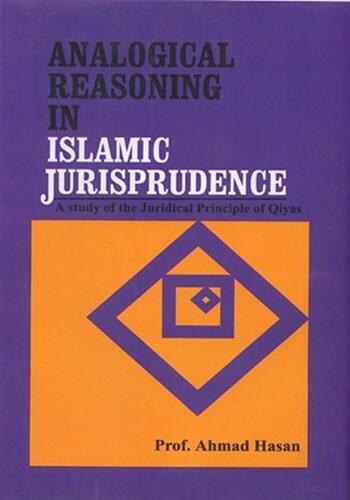


Analogical Reasoning In Islamic Jurisprudence
by Prof. Ahmad Hasan
About The Book
Qiyas (analogy) is one of the four sources of Islamic law. unlike other modes of ijtihad. It is a process of systematic reasoning to discover the legal rule. It is dependent entirely on an authority, which may he the Qur'an, Sunnah or Ijma. It is the most important principle of deriving rules from the original sources. Most of the legal material contained in the Fiqh literature is an outcome of analogical deductions.
This study falls into 20 chapters. It deals with the concept, rules, and application of Qiyas (analogy) in law. The early chapters contain a general treatment of this principle. They are followed by the chapters which present a detailed analysis of the definition of Qiyas (analogy), the original and the parallel case, the definition, and conditions of the legal cause ('illah) and the methods of its determination. The principle of istihsan (preferential reasoning), rules of immediate cause (sabab), condition (shart), impediment (mani) and critique of Qiyas are some of the important chapters.
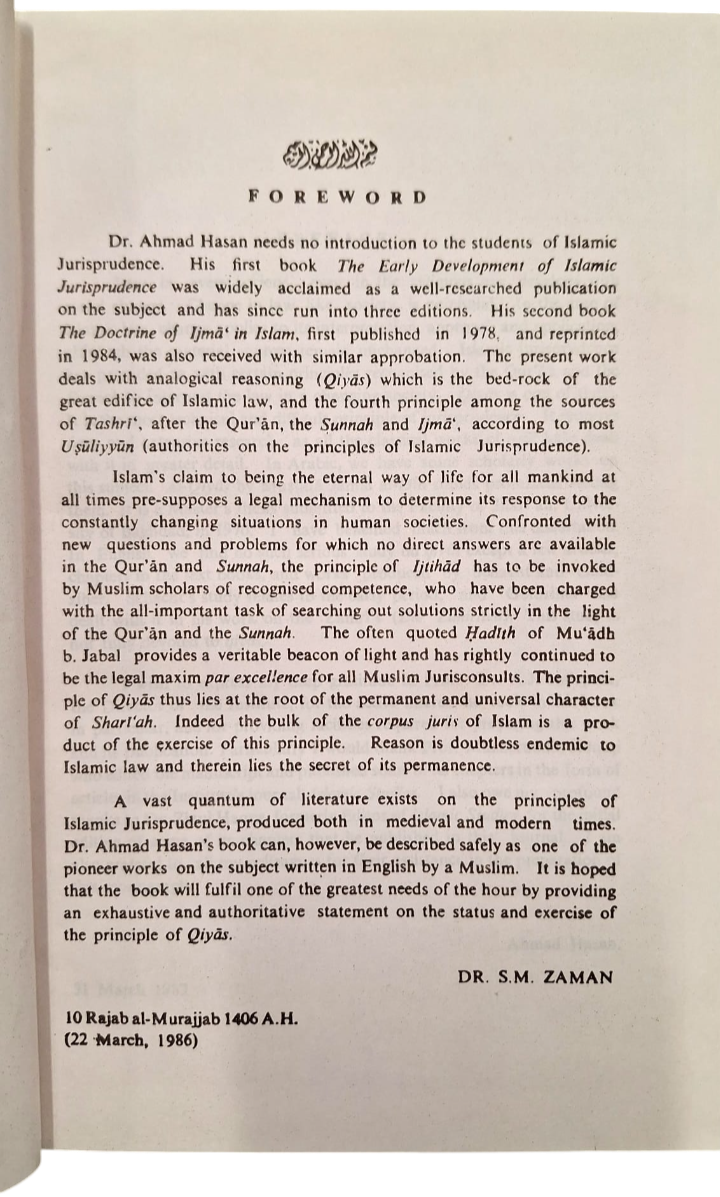
Prof. Ahmad Hasan needs no introduction to the students of Islamic jurisprudence. His first book The Early Development of Islamic Jurisprudence was widely acclaimed as a well-researched publication on the subject and has since run into three editions. His second book The Doctrine of Ijma in Islam, first published in 1978, and reprinted in 1984 was also received with similar approbation. The present work deals with analogical reasoning (Qiyas) which is the bed-rock of the great edifice of Islamic law, and the fourth principle among the sources Tashri, after the Qur'an, the Sunnah and Ijma, according to most Usuliyyun (Authorities on the principles of Islamic Jurisprudence).
Es existieren noch keine Bewertungen - geben Sie zuerst eine ab.


